

HDP Nexus for Forced Displacement Response
HDP Nexus for Forced Displacement Response

The project in brief
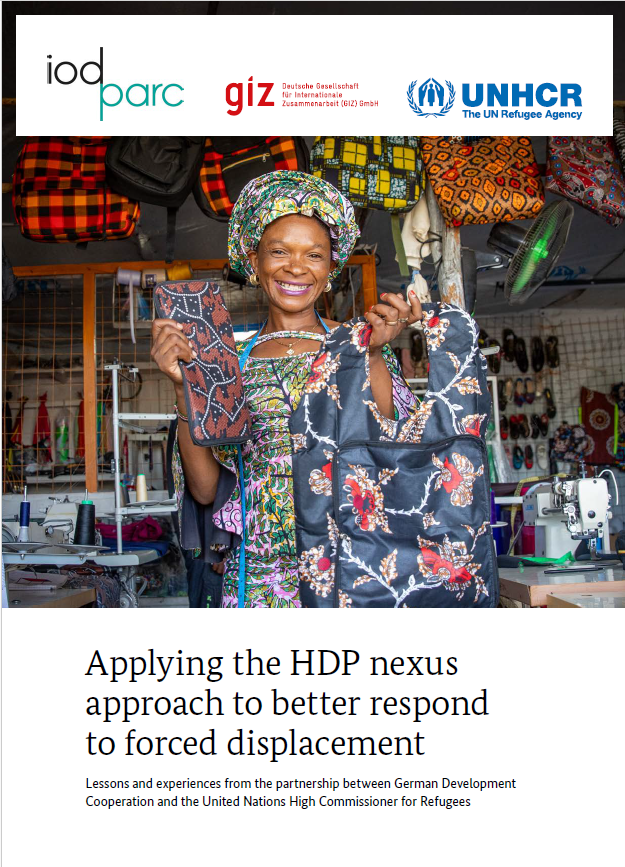
The project is implemented by Deutsche Gesellschaft für Internationale Zusammenarbeit (GIZ) and the United Nations High Commissioner for Refugees (UNHCR). It began in February 2022 and ended in August 2025. Between February 2022 and March 2025, UNHCR and GIZ conducted a joint longitudinal study, realized by IOD PARC and the Global Public Policy Institute. The study asked: “How can HDP nexus approaches be used to better respond to forced displacement and put into practice the objectives of the GCR?”. It provides lessons learnt, achievements, and areas requiring improvement in future collaboration, aimed at supporting learning for UNHCR, GIZ, government authorities and humanitarian and development actors.
The project's aims include:
- Understanding: “How can HDP nexus approaches be used to better respond to forced displacement and put into practice the objectives of the GCR?”
- Documenting lessons learnt, achievements, and areas requiring improvement in future HDP collaborations.
- Providing practical recommendations to humanitarian and development actors seeking to engage in HDP partnerships.
Main activities of the Good Practice
Elements which helped facilitate the implementation of the good practice
- The study builds on an iterative process of extensive document reviews, in-country and desk-based data collection, and stakeholder consultations.
- Trust and access to in-country stakeholders, including governments, displaced populations, and host communities.
Partners involved
- BMZ
- GIZ
- UNHCR
- IOD PARC
- Global Public Policy Institute
What challenges were encountered in delivering the project and how were they overcome?
Challenges
How they were overcome
Results of the Good Practice

In what way does the good practice meet one or more of the four objectives of the Global Compact on Refugees?
Objective 1: Ease the pressures on host countries
Objective 2: Enhance refugee self-reliance
By enhancing the socio-economic integration and self-reliance of refugees and host communities, they strengthen self-reliance.
Objective 4: Support conditions in countries of origin for return in safety and dignity
And by contributing to social cohesion, applying conflict sensitivity, and promoting peacebuilding, they support conditions in countries of origin for safe and dignified return.
Next steps
The study has been finalized, its learnings have informed the cooperation and joint projects among BMZ, GIZ and UNHCR. The focus will be on distributing lessons learned and sharing good practices.
Contact the project
Refugee Inclusion Accelerator