

How the Global Compact on Refugees and the Global Compact for Migration complement each other
How the Global Compact on Refugees and the Global Compact for Migration complement each other
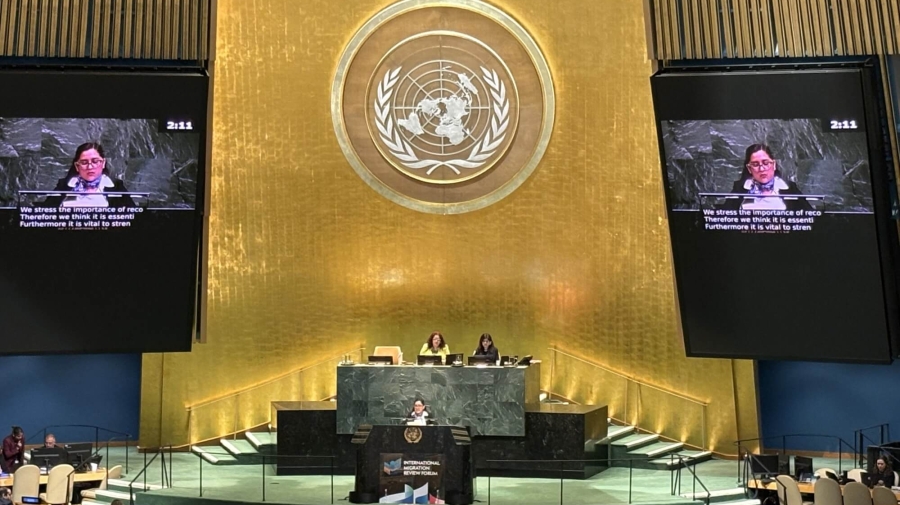
Ms. Fátima Ríos, Director General for Human Mobility and Development, Ministry of Foreign Affairs, Mexico, delivering the statement on behalf of like-minded States
As the second International Migration Review Forum (IMRF) convened in New York from 4 to 8 May, various side events were held alongside the formal plenary discussions to shine a spotlight on the needs and rights of migrants, including in mixed movement situations where both migrants and forcibly displaced people travel on the same routes. The distinction between these groups is important and recognized by both the Global Compact on Refugees (GCR), which seeks to protect forcibly displaced and stateless people, and the Global Compact for Safe, Orderly, and Regular Migration (GCM), which works to manage migration. The Compacts complement one another in a number of areas but this complementarity must not be understood as blurring the distinct legal status, rights, and protection needs of refugees and migrants.
Different protection needs, shared challenges
Refugees and migrants are not the same. Refugees are forced to flee due to persecution, conflict and violence, and are entitled to international protection under the 1951 Refugee Convention and other regional legal frameworks. Migrants move for a wide range of reasons including economic opportunity, family, and education, and different human rights treaties articulate migrants’ rights. A key distinction is that, unlike refugees, migrants can return home without fearing persecution, conflict or violence. This is why conflating the two groups undermines the protection that refugees specifically require and fuels political narratives that drive anti-refugee and anti-migrant sentiment.
Yet refugees and migrants may travel along the same routes, face some of the same dangers, and arrive at the same borders. The international response must be capable of distinguishing between them while protecting everyone and ensuring their rights.
And that is what the two Compacts, both affirmed in 2018, seek to do; providing protection and support to their respective groups, while working in a complementary way to reduce gaps in response and ensure people do not fall through them.
What the Compacts share
Both the Global Compact on Refugees and the Global Compact for Migration emerged from the 2016 New York Declaration and share a commitment to multilateralism, human rights, and the realization that no State can manage forced displacement or migration alone. Both recognize that solutions require cooperation from across the international community, and both call for the meaningful participation of the people they concern – refugees and migrants – in the decisions that affect their lives.
On several issues, the two Compacts’ objectives closely align. From life-saving responses along dangerous routes and the fight against trafficking and smuggling, to ending the arbitrary detention of people on the move, approaches grounded in both frameworks are stronger and more efficient than those operating in isolation.
Furthermore, the GCR and GCM call for the integration of refugees and migrants, respectively, into national and local development plans and recognize the need to incorporate human rights into climate action. Both the GCR and GCM support the inclusion of refugees and migrants, respectively, in health and education systems, as well as the mutual recognition of qualifications.
This complementarity is recognized by States. On 7 May, at the IMRF in New York, a joint statement was delivered by Mexico on behalf of like-minded States. Among other things, it called for States and partners to support and advance a route-based approach in the context of mixed movements of refugees and migrants, by strengthening coordination and operational complementarity between the GCM and the GCR. This very much aligns with the Secretary General’s call made at the opening of the IMRF to strengthen synergies between the two Compacts. Read the full statement in English and Spanish.
And where they differ: refugee protection vs. migration governance
Complementarity does not mean equivalence or conflation. The pathways for migration and for refugee protection are distinct and must remain so.
A key difference is in the two wholly separate groups of people that the two compacts serve. Refugees are entitled to international protection, a legally binding set of laws which places the responsibility on Member States. As such, the Global Compact on Refugees is a framework for responsibility-sharing across the international community, aiming to ensure refugees have full access to their rights, while easing pressures on host countries by notably enhancing refugees’ self-reliance, expanding third-country solutions and working in countries of origin towards conditions conducive for voluntary and safe return.
Meanwhile, the Global Compact for Migration works to create more orderly and predictable migration flows, including by minimizing drivers of migration and strengthening border management.
And while both Compacts seek to enforce their respective groups’ rights, these rights are not the same. For example, rights-based approaches to return, readmission and reintegration look different depending on whether someone is a refugee or a migrant, and applying the wrong framework can have serious, sometimes life-threatening consequences for individuals.
Protection-sensitive entry systems are essential precisely for this reason, to direct people arriving at borders to the right processes and services, including asylum systems where relevant, and to ensure that the distinction between refugees and migrants is respected in practice, not just in policy. In their joint statement, the States called on countries “to ensure that the distinctive status of refugees and their need for international protection remain upheld.”
An opportunity for collaboration
As Member States, civil society, and the private sector gathered to review progress on the GCM, the case for complementarity is not abstract. It is visible in the shared challenges of mixed movements, in the human rights that apply to everyone, and in the efficiencies that a coordinated approach makes possible.

