

Japan’s Global Refugee Forum Network comes together for a refugee-inclusive society
Japan’s Global Refugee Forum Network comes together for a refugee-inclusive society
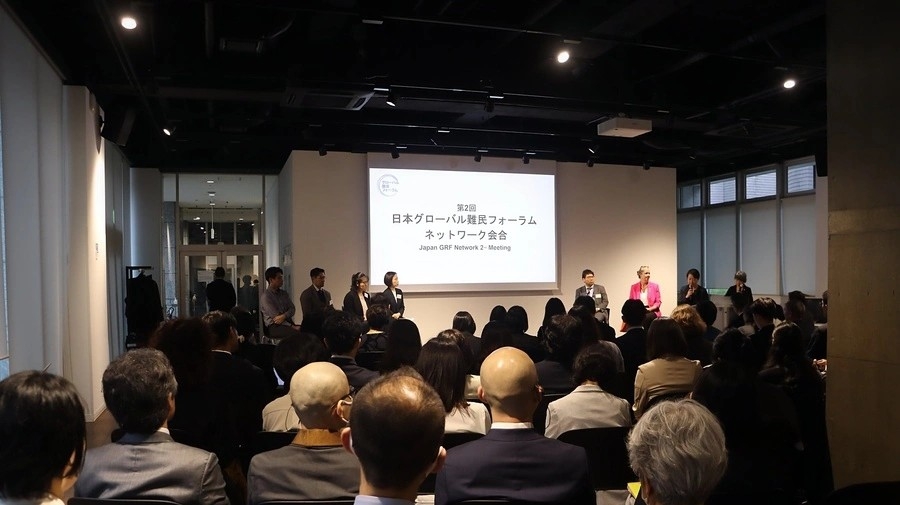
Japan Global Refugee Forum Network 2nd Meeting
In late April, the Ministry of Foreign Affairs of Japan (MoFA) and UNHCR Japan co-hosted the second meeting of the Japan Global Refugee Forum (GRF) Network.
The Network was established following the second Global Refugee Forum held in Geneva, Switzerland, in December 2023. It serves as a platform for sharing progress, good practices, and challenges in implementing the more than 40 pledges submitted by various stakeholders in Japan. The Network aims to promote a “whole-of-society” approach to supporting refugees and their host communities. As one of the co-convenors of the GRF 2023, Japan demonstrates strong leadership in the international community to promote collective responses to forced displacement situations.
In the opening remarks, Hideki Kusakabe, Deputy Director-General of the International Cooperation Bureau of MoFA, highlighted the growing severity of the global forced displacement situation. He mentioned Japan’s emergency assistance to humanitarian crises in countries such as Lebanon and Myanmar and emphasized the importance of whole-of-society efforts, including those of the private sector and civil society. At a time when aid faces severe financial cuts, he welcomed the level of donations to Japan for UNHCR, and stressed the significance of the upcoming Ninth Tokyo International Conference on African Development (TICAD9) and the Global Refugee Forum Progress Review (the second high-level officials meeting) scheduled for December this year. He concluded by expressing his appreciation for the opportunity to engage with active stakeholders in Japan and his hopes for further collaboration and solidarity.
UNHCR Deputy High Commissioner Kelly T. Clements, expressed gratitude for Japan’s continued support and the proactive efforts made by the pledging actors after the GRF 2023. She emphasized the relevance of the Global Compact on Refugees amid worsening humanitarian crises and funding shortfalls witnessed globally. She also underscored the importance of Japan’s leadership in promoting the Humanitarian-Development-Peace (HDP) Nexus — one of the country’s key focuses.
Updates on the pledges submitted from Japan
Soka Gakkai
Soka Gakkai, a faith-based organization, reported that it mobilized around 400 participants since last year through film screenings organized under the “Refugee Film Festival Partners” initiative in cooperation with Japan for UNHCR, and through exhibitions on refugee issues. The organization also conducted awareness-raising activities via its media platforms and donated advertising space. In collaboration with the NGO Musicians Without Borders, it has been supporting music education and training for both refugees and local children in Jordan, including music therapy.
Youth with Refugees Platform
The youth-led platform has partnered with 16 youth organizations, holding regular meetings, advocacy events, and study sessions. It has also engaged forcibly displaced youth and organized events targeting youth generations, fostering cross-generational and cross-regional participation. Key challenges remain in strengthening international outreach and collaboration.
Sony Group
Sony signed a partnership agreement with UNHCR in September 2023 under the “COVID-19 Sony Global Relief Fund.” It committed to providing USD 6 million over three years starting from 2023, of which USD 4 million has already been delivered. The support includes initiatives to improve health, water, and sanitation conditions in places including Bangladesh and Southern Africa. Employees have visited project sites to explore more effective ways of using Sony’s technology and resources in refugee assistance.
Pathways Japan
Pathways Japan supports access to higher education and self-reliance for refugees in Japan. It aims to accept 96 students by 2027 in collaboration with Japanese language schools and universities. So far, 43 students have received Japanese language education support, 20 of whom were subsequently enrolled at university. Through the Toshizo Watanabe International Scholarship Program, Pathways Japan plans to support a further 77 students over the period of four years, with 33 entering university in 2025. The initiative contributes to the Multi-stakeholder Pledge working towards 15% enrolment of refugee youth in higher education by 2030.
Ministry of Foreign Affairs of Japan (MoFA)
As a leader of the HDP Nexus Multi-stakeholder Pledge, Japan is following up on its implementation at multiple levels. For instance, MoFA supports both refugees and host communities in Bangladesh, including Cox’s Bazar and Bhasan Char, in cooperation with UN agencies including UNHCR. Japan also continues its refugee resettlement program with a focus on economic and social inclusion in the Japanese society. Looking ahead to Global Refugee Forum Progress Review 2025 in December, MoFA expressed its intent to accelerate the pledge implementation in collaboration with relevant stakeholders in Japan.
It was followed by a session, which explored the theme of “inclusion” through concrete examples and challenges shared by the Japanese Government, municipalities, and businesses on how refugees are being supported into education and employment and becoming self-reliant.
Japan International Cooperation Agency (JICA)
JICA shared its support based on the HDP Nexus approach to foster inclusive and peaceful coexistence of refugees, internally displaced people, and host communities. Its cooperation with the Government of Kenya’s Shirika Plan, and efforts in Uganda and Zambia to enhance inclusive regional development and livelihood improvement were highlighted as examples of how Japan is working collaboratively with host countries to support them in implementing their pledges. JICA also introduced a business idea contest, exploring innovative and sustainable solutions to various issues concerning forced displacement and harnessing the potential of the private sector.
City of Yokohama
Yokohama introduced its multicultural initiatives involving partnerships with companies, NGOs, and citizens. Those who were once recipients of support are now actively involved as providers, engaging in various activities such as running Japanese language classes and offering assistance in navigating daily life. For people who have fled from Ukraine, the city has shifted its approach from offering emergency shelter and interaction spaces to promoting self-reliance, emphasizing the need for flexible responses based on changing needs.
Welcome Japan
Welcome Japan, a platform to strengthen business engagement in refugee inclusion, presented its efforts in employment support, skills development, mental health care, Japanese language education, and access to housing. It also developed and provided the Cultural Diversity Index, a tool to promote inclusive hiring and evaluation practices, and launched the CxO Council, a network of business leaders. These efforts demonstrate the unique strengths of the private sector.
Fast Retailing
Fast Retailing, the multinational company whose subsidiaries include Uniqlo, shared its extensive refugee support activities through a two-decade-long global partnership with UNHCR. These activities include clothing donations, and programmes promoting self-reliance, refugee employment, and school outreach for elementary, junior, and high school students. Drawing from its experience, the company emphasized the importance of continually reviewing and adapting its initiatives based on results and challenges.
During the Q&A session, participants actively discussed topics such as how to ensure meaningful participation of refugees and how to maintain solidarity in the face of escalating crises and resource constraints.
In her closing remarks, Taeko Kuwahara, Officer-in-Charge of the UNHCR Representation in Japan, noted that UNHCR has witnessed the expansion of refugee support efforts across Japanese society through the actions of diverse stakeholders. She emphasized that activities leveraging each actor’s expertise complement one another, enhancing both the quality of support and advocacy outcomes. She reaffirmed UNHCR’s commitment to working with partners in Japan to ensure the sustainability of collective efforts in advancing forced displacement agenda.
Related content
