Renewed Multi-Stakeholder Coordination in Cox’s Bazar
Renewed Multi-Stakeholder Coordination in Cox’s Bazar
Sexual and gender-based violence (SGBV) is a pervasive global crisis that not only violates human rights and dignity but also functions as a fundamental developmental challenge deeply woven in societal fabrics. In Bangladesh, this crisis is alarmingly evident, where an estimated seven in ten women1 have experienced one or more forms of intimate partner violence in their lifetime.
The situation in Cox’s Bazar – a south-eastern district hosting more than 1.1 million stateless Rohingya people from Myanmar – demands urgent attention. The 2017 influx of Rohingya refugees has placed the whole district, including its people, administrative, judicial, and protection systems under severe stress. Already one of the poorest regions of the country, Cox’s Bazar now sees a complex set of vulnerabilities turning into a hotbed of SGBV issues further worsened by the precarious conditions within the 33 refugee camps.
Responding effectively to SGBV issues both in host and Rohingya communities requires an informed, coordinated, and multi-stakeholder approach. Especially in Cox’s Bazar, it demands an approach that moves beyond traditional humanitarian support, complementing the Humanitarian-Development-Peace Nexus. Current efforts put in place are hampered by significant systemic issues: cultural and social barriers that prevent reporting, inadequate and unequal access to the SGBV services, service providers not being adequately trained, an insufficient adoption of gender-sensitive approaches, and a lack of coordination among actors addressing SGBV. On top of that, the heavy backlog in the legal system, compounded by the issue of SGBV being underprioritized, means that justice is almost always delayed or denied. Moreover, the lack of gender-sensitive service provision and inadequate coordination among actors addressing SGBV results in fragmented and often insensitive support. These barriers highlight a critical need to invest in the national human capital responsible for the entire SGBV response chain.
Japan International Cooperation Agency (JICA)’s Multi-Sectoral Capacity Building Approach
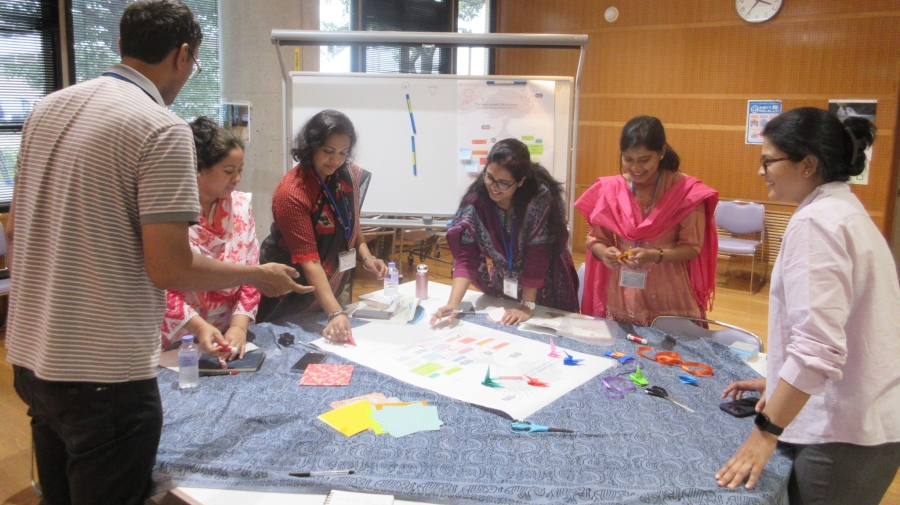
The Global Compact on Refugees recognizes SGBV as a deeply rooted developmental issue which requires coordinated action from all stakeholders. In response, JICA initiated a capacity-building project that targeted government and non-government officials working for the SGBV response chain in Cox’s Bazar. Partnered with the Ministry of Women and Children’s Affairs (MoWCA), the project's strength lay in its multi-ministerial participant team, designed to foster cohesive understanding and coordinated action across all service sectors. The three-week training programme in Japan in July 2025 was organized by JICA in partnership with the National Women’s Education Center (NWEC).
Participants included policymakers, judicial and law enforcement officials, a doctor in charge of the One Stop Crisis Center (OCC), social service and protection officials, government officials in charge of Rohingya camps (known as Camp-in-Charges), and SGBV experts from non-government organizations. This composition ensured that discussions were comprehensive, linking policy decisions with field level implementation and judicial outcomes, thereby directly addressing the coordination gap.
The training curriculum was designed to be foundational yet practical. Contents focused on basic concepts such as gender and its non-binary nature, gender roles and norms, and the psychological aspects of violence. Critically, it examined how toxic masculinity and patriarchy act as driving forces of SGBV, broadened the definition of SGBV beyond its most obvious physical nature, and emphasized implementing a gender-sensitive approach in all service delivery.
The practical components focused giving participants an immersive experience of how Japan addresses SGBV issues, covering its national laws and policies, life safety education in pre and primary schools, and the use of trauma-informed care. Participants were also introduced to essential tools of response, including helplines, referral chains, rescue centres, and safe spaces. To bridge theory and practice, the programme incorporated essential field visits: one to an entertainment district in Shinjuku to understand the vulnerable environment faced by sexual service providers and another to rescue centres and women’s safe spaces to gain an experiential understanding of how sensitive, survivor-centred care is delivered.
The mix of interactive lectures, cross-cultural discussion sessions, and practical field visits proved immensely fruitful. Not only was it helpful to draw compelling similarities between Japanese and Bangladeshi societies concerning traditional gender roles and norms, but it also showed how Japan embraced gender-sensitive approaches in its operations, serving as potential informed and gender-sensitive practices to contextualize and apply.
JICA’s training shows a crucial pathway for development partners to contribute meaningfully to complex and protracted humanitarian crises like the Rohingya response. By focusing on strengthening national systems and building local human capital in a critical area like SGBV, the project ensures our cooperation has a sustainable impact that benefits both the refugee population and the host community in the long run. In doing so, it directly supports the Multi-stakeholder Pledge to Accelerate and Better Leverage Humanitarian-Development-Peace Nexus Approaches in Forced Displacement Settings, which Japan officially pledged towards at the Global Refugee Forum 2023, offering a concrete model for implementation in Bangladesh that could inspire similar approaches in other displacement contexts.
1Key findings of Violence Against Women Survey Bangladesh 2024
In the spirit of responsibility-sharing and a multi-stakeholder approach in the implementation of the Global Compact on Refugees, some articles and news stories on this platform are submitted by States and other stakeholders themselves. They do not necessarily reflect the official policy or position of UNHCR and its employees. While we have made an attempt to ensure that the information contained on this platform has been obtained from reliable sources, UNHCR is not responsible for any errors or omission, or for the results obtained from the use of this information.
Should you have any comments or queries, or wish to bring to our attention any inaccuracies on the platform, please contact [email protected].
Related content