JICA – Laying the Ground for Forcibly Displaced Populations to Return Home Safely
JICA – Laying the Ground for Forcibly Displaced Populations to Return Home Safely
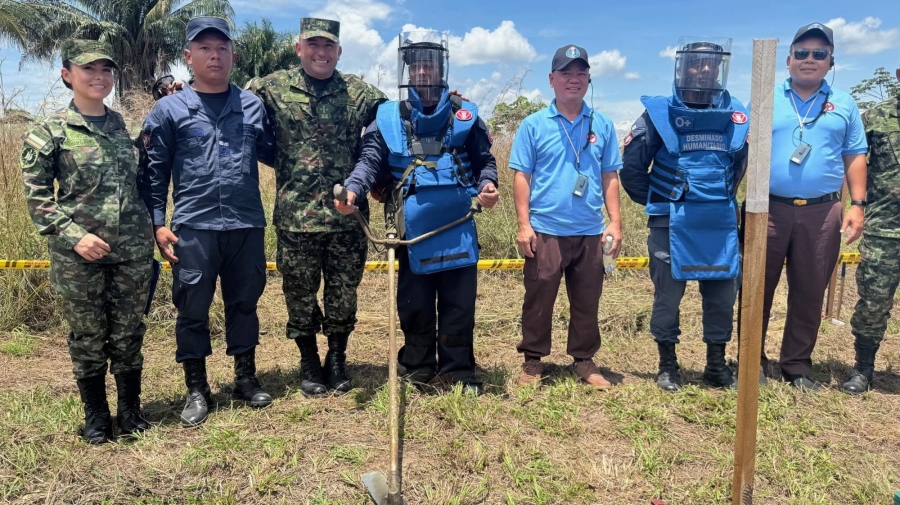
Cambodian demining trainers in Colombia, participating through JICA’s training scheme
In 1996, Cambodia experienced one of the highest casualty rates from unexploded ordnances and land mines. Why? This was the year when Cambodian refugees were returning home from Thailand, and yet their land was not as they had left it. Scattered among remains of homes, communal spaces, roads and agricultural land were landmines – deadly, undiscriminating remnants of wars which can destroy lives decades after a conflict has ended.
Landmine casualties occurs when people start moving. Even as conflict and violence subside, refugees and internally displaced people cannot safely return home, unless areas affected by landmines have been adequately assessed and cleared. There is a direct link between mine action activities and the fourth objective of the Global Compact on Refugees – to support conditions in countries of origin for forcibly displaced people to be able to return home in safety and dignity.
Over the past 30 years, the Japan International Cooperation Agency (JICA) has been supporting communities to return to their homes through their expert demining programmes.
JICA’s approach to mine action– national capacity development and mainstreaming
JICA works by empowering national organizations to develop the expertise to identify and safely clear priority areas in their regions, raising awareness among local people on how to recognize risks and move safely in affected areas, and providing advanced technology and machines to enable more effective and safer demining activities. Together with countries such as Cambodia, who have built up national expertise and institutions over time, JICA also provides opportunities to share this knowledge and capacity with other countries and within regional platforms.
But mine action is not only essential to protect people on their route home, it is inextricably linked to reestablishing their lives and communities in safety. When returnees begin to rebuild their lives, they need water, education, and basic infrastructure and services, the development of which cannot be realized without addressing the landmines in their area. JICA is working to incorporate mine action activities and awareness into activities of other sectors, such as agriculture, health and infrastructure. As long as landmines remain, people cannot return home safely, nor can agricultural land be used productively. Removing explosives contributes to raising productivity and enabling communities to restore their livelihoods to become self-reliant.
Early response from the outset of conflicts and throughout protracted conflicts
JICA’s expert in peacebuilding, Eri Komukai, emphasizes that it is too late to commence mine action, including Explosive Ordinance Risk Education (EORE), after a conflict. EORE for affected populations should start at the outset of conflicts. Communities need localized information about their areas, guidance on how to avoid the risks and danger posed by landmines, and details on who to contact for support when such objects are found, all provided in a timely manner. Providing EORE in refugee and IDP camps before displaced people consider returning has proven highly effective in raising awareness of the risks they may face, whether during their journey or upon returning to their land.
In Sudan, for instance, where many Sudanese people wish to return to Khartoum, the UN Mine Action Service (UNMAS) Sudan, has had to discourage return due to the high number of explosive ordnances and landmines.
Rather than waiting for complete peace, risk management is now being prioritized. While a full-scale demining survey is only possible after conflict ends, delaying actions leads to injuries and casualties, cautions Eri Komukai. For this reason, the international community is focusing on preventive measures, such as raising awareness on self-protective measures and marking hazardous areas early. In places including Lebanon, Syria and Sudan, where extreme poverty and conflict, where people cannot afford to wait for expert help, these interventions remain critical.
Meaningful participation of Communities and Vulnerable Groups
While JICA prioritizes capacity development of national organizations, it also ensures that these authorities are trusted and responsive to the people they serve. Demining activities need to be informed by the voices of both locals and returnees. For example, in the early stages of demining in Cambodia, there were criticisms that the selection of the locations for demining activities were not transparent. To ensure demining contributes to poverty reduction and development, transparent and accountable processes for prioritizing and selecting sites are essential. With so many locations requiring demining, decisions need to be made based on multiple criteria, including national, regional and local development plans, reflecting the voices of the people, and including vulnerable groups.
In Cambodia, large volunteer networks have been established over many years actively engaged in EORE. These networks enable any local resident or returnee who finds a suspicious item to report it to the local village chief or leader, who then relays the information to the closest demining unit to remove the explosives. The information is also disseminated in the community networks to ensure that local residents are well-informed, remain safe, and that responses to potential threats are quick, effective and safer for everyone.
JICA’s global demining programme – knowledge sharing platforms and new Japanese technologies
JICA works bilaterally with governmental organizations to develop national capacity. JICA’s approach is to support the development of national capacity to ensure that they can sustainably address the risks over time, to bring safety and life back to their communities and people. UNMAS and international NGOs can support in the emergency period with EORE.
JICA has mine action programmes in Cambodia, Colombia, Laos and Ukraine and other affected countries, and facilitates linkages between these countries. For Cambodia, Colombia, Laos and Ukraine, JICA promotes the use of new advanced Japanese technologies and machines, which have proven much more effective in increasing the safety and efficiency of the operation on the ground.

Through the newly established “Africa Mine Action Platform”, JICA has been collaborating with UNMAS in supporting key countries in Africa affected by landmines, including Nigeria, South Sudan, Ethiopia and Somalia. Using an HDP Nexus approach and collaboration with UNMAS field offices in these locations, JICA is investing in developing national capacity, so that these countries can sustain mine action efforts independently. This platform also enables these countries to learn from Cambodia’s experience over the past 25-30 years.
Through these efforts, JICA aim to foster peacebuilding and peaceful coexistence between forcibly displaced and host communities, ultimately contributing to the realization of returning home in safety and dignity - the fourth objective of the Global Compact on Refugees.
In the spirit of responsibility-sharing and a multi-stakeholder approach in the implementation of the Global Compact on Refugees, some articles and news stories on this platform are submitted by States and other stakeholders themselves. They do not necessarily reflect the official policy or position of UNHCR and its employees. While we have made an attempt to ensure that the information contained on this platform has been obtained from reliable sources, UNHCR is not responsible for any errors or omission, or for the results obtained from the use of this information.
Should you have any comments or queries, or wish to bring to our attention any inaccuracies on the platform, please contact [email protected].
Related content