Pledge fulfilled: a whole-of-society approach to integration in Scotland
Pledge fulfilled: a whole-of-society approach to integration in Scotland
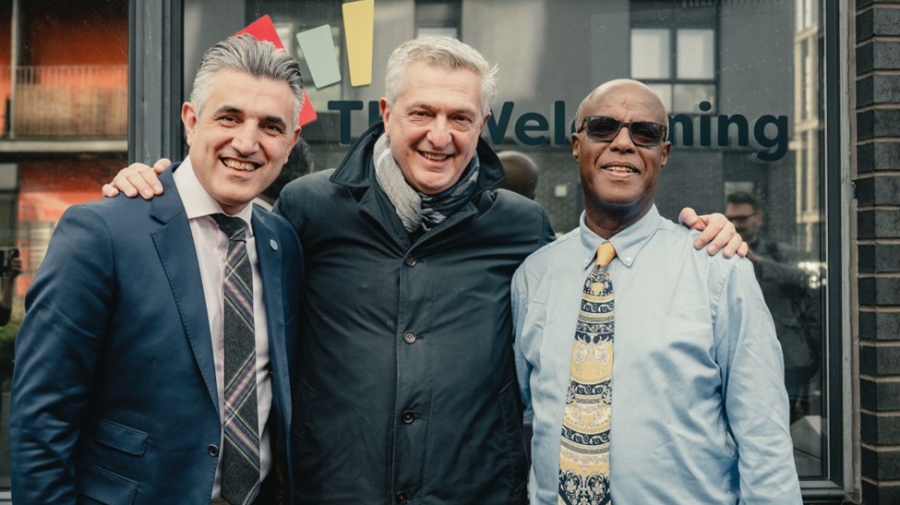
UNHCR High Commissioner Filippo Grandi met with Scottish Refugee Council Chief Executive Sabir Zazai (left) and The Welcoming Chief Executive Tesfu Gessesse (right) during a visit to Edinburgh, Scotland in March 2025 to see how civil society groups were taking a lead in making the New Scots strategy a reality for refugees and asylum-seekers in Scotland
In 2013, the New Scots Refugee Integration Strategy was launched, heralding an innovative approach to refugee integration across Scotland. Introduced five years before the Global Compact on Refugees called for a ‘whole-of-society' approach - with a range of actors working together to more equitably welcome refugees and support host countries - the strategy established an inclusive, multi-stakeholder approach to welcoming forcibly displaced people.
Created in partnership between the Scottish Government, the Convention of Scottish Local Authorities (COSLA) and the Scottish Refugee Council, the strategy recognizes the contributions that refugees and asylum-seekers have made over many generations and continue to make to Scotland and its social and cultural life. The New Scots highlights the ‘multidirectional’ nature of integration, asserting that the process of integration between newcomers and new communities consists of action on both sides, with the wider Scottish society evolving and growing alongside new members.
The original 2013 strategy covered the period up to 2018, when a second iteration was launched. Then, at the Global Refugee Forum in December 2023, a decade after the initial launch, the Scottish Government, COSLA, and Scottish Refugee Council pledged to release a third version. This latest edition was released in 2024 alongside a delivery plan.
Unlike the previous versions, the 2024 strategy is not time-bound. It aims to provide a long-term blueprint, flexible and adaptable enough to meet ever-changing needs, while offering stability and reassurance to stakeholders supporting forcibly displaced people in integrating and achieving their full potential. The delivery plan is also designed to be adaptable and updatable, while detailing specific actions and timelines.
The New Scots Strategy has six key principles, integral to ensuring its success. The first principle is that integration needs to be prioritized from day one of arrival. Early integration leads to better health, wellbeing, and employment outcomes, benefiting both newcomers and the host community.
The second principle is that the strategy provides a rights-based approach, enabling refugees, asylum-seekers, and stateless people to know and exercise their rights, while also improving the accountability of those whose duty it is to ensure access to these rights.
Thirdly, the strategy calls for approaches which are restorative and trauma-informed, recognizing the prevalence of trauma in forcibly displaced people. It aims to respond in ways that reduce the impact of trauma, support recovery, and avoid re-traumatization, so that people can feel safe and have more control of their lives.
The fourth principle is to ensure the meaningful and sustained participation of people with lived experience of forced displacement in all levels of decision making related to the strategy. The New Scots Strategy looks to build on lessons learned over the last decade and increase the sharing of good practices to improve the quality and extent of participation.
The fifth principle is to build inclusive, intercultural communities that promote mutual leaning so that both New Scots and host community members can share and benefit from different cultures. This involves developing knowledge of – among many things – music, games, food, and language, so everyone is included.
The final principle is that the strategy is built on partnership and collaboration, to effectively coordinate the efforts of government, local authorities, and non-governmental organizations, to work together as equals towards a more welcoming Scotland.
Scotland’s approach to integration has long been recognized in the international community, with UNHCR, the UN Refugee Agency, acknowledging the strategy’s long-standing dedication to creating a welcoming nation for forcibly displaced people.
In an age where hate speech, disinformation, misinformation, and negative rhetoric towards refugees and asylum-seekers is on the rise, Scotland’s approach gives hope and provides a blueprint for a different course of action.
To find out more about the New Scots Strategy in action and about integration in practice in Scotland, visit the New Scots website.
Further information
Related content