Interview with Maryanne Rimbao
Interview with Maryanne Rimbao

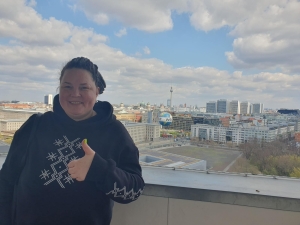
Maryanne at the Annual Meeting of the Action Network on Forced Displacement, standing on the balcony of the German Federal Ministry for Economic Cooperation and Development.
Maryanne Rimbao is the Founder and Director of Humanity and Nature Indigenous Women’s Association in Papa New Guinea and a Member of the Action Network on Forced Displacement. Her work powerfully advances the Global Compact on Refugees (GCR) by enhancing the self-reliance of internally displaced indigenous women through education, skills training, legal aid, psychosocial support, and sustainable livelihoods (GCR Objective 2). Her peacebuilding initiatives, environmental restoration efforts, and advocacy for systemic change contribute to creating safer, more stable conditions that support voluntary return in dignity (GCR Objective 4). Additionally, Maryanne's strong commitment to gender equality, LGBTIQ+ inclusion, and protection from gender-based violence (GBV) reflects the GCR’s cross-cutting emphasis on inclusive, gender-responsive approaches.
At the Annual Meeting of the Network in Berlin, Germany, she sat down to share about the work she does through the organization she founded.
Maryanne focuses primarily on helping indigenous women and girls affected who have been displaced internally within Papa New Guinea because of conflict between tribes.
The challenges she described are immense and wide-ranging, and some of the stories of the violence she has witnessed are harrowing. Yet Maryanne remains optimistic, passionate but calm, and overflowing with empathy.
Internally displaced people in Papa New Guinea often face a wide range of challenges, including lack of access to water, sanitation systems and electricity, and particularly in relation to employment. They are frequently unable to get good jobs, are paid less than non-displaced people, and given lower yielding land for agriculture, making self-sufficiency even more difficult. Women can often only find seasonal employment, leading to mass forced redundancies when the work ends.
Forcibly displaced women and girls face increased risks of GBV, including sexual exploitation, trafficking, and forced marriage, because of harmful coping strategies driven by extreme economic hardship, often leading to the loss of education and protection. Maryanne shares that: "Women and girls are at risk of rape and being trafficked or sold for sex work by male family members desperate for food or better job positions. Girls are sold for marriage against their will, losing access to years of education."
Maryanne explains that there are three main drivers behind this: "Conflicts between tribes can lead to women being sold in bargaining and truces; large scale violence leading to greater instability and more people being forcibly displaced; and women at highest risks, including widows, being attacked, who are either severely injured, killed, or forced to flee, and have their land stolen, sometimes by the accuser."
And adding pressure to all of this is the high level of pollution and environmental degradation the country is facing, harming people’s health, impacting access to clean water, and making agricultural production all the harder.
Maryanne’s work covers a wide range of areas, from environmental protection and promotion of cultural and language education to peacebuilding efforts and helping women and girls escape persecution. The GCR highlights such work as imperative for supporting conditions for displaced people to return in safety and dignity.
She talked of the lack of awareness of the right to an education, that girls often don’t know of this, nor how to express it. In line with Maryanne's work, the Multi-stakeholder Pledge on Securing Sustainable Futures - Towards a Shared Responsibility to Uphold the Right to Education and Include Refugee Children in National Education Systems, work is being done to ensure more displaced children, particularly girls, are able to access education.
Her organization has a shelter, and a second is being built to respond to the demand. Such shelter provides temporary support to girls during time of conflict, and trains women and girls in cultural skills, including making traditional clothing and jewellery.
Maryanne is supported by two lawyers who work pro-bono – for free – providing advice and legal support to victims of violence and forced displacement, as well as two doctors at the local medical facility, and a psychologist who volunteers to provide psychosocial support each Saturday.
Additionally, the organization provides self-defense classes coupled with psychosocial support, particularly in areas where a lot of mining takes place, as women and girls are at an even greater risk of sexual violence there. As Maryanne says: "better to protect and prevent than provide relief after". And she would like to see an improved clinical management of rape across the country and increase access to justice to improve the chances that perpetrators are brought to justice.
Maryanne has worked with the Government to review the voting system, hoping to introduce biometric fingerprint scanning to ensure women are voting themselves, as without this it is possible for their votes to be taken from them by male family members.
Maryanne also uses her indigenous knowledge in reforestation projects, working to improve agricultural land to increase food supplies and jobs and planting trees near the sea where pollution is high.
All this work is guided by Maryanne’s Christian beliefs, she explains, saying: "Do good to others as they do good for you". But it has come at a great personal cost. She faces threats to her safety because of the work she does, and, because Maryanne’s work includes advocating for abortion access and the rights of the LGBTIQ+ community, she has not spoken to her mother for a long time.
But Maryanne remains optimistic for the future. She would like to expand her shelter to include a training centre with 50 sewing machines and screen-printing facilities to make the organization self-sufficient.
She is hopeful that in the general election in 2027, at least ten female MPs will be elected, highlighting how more gender balance in representation can lead to higher levels of sustained peace. And she would also like to see the introduction of a human rights commissioner in the Government to help people more easily access and uphold their rights.
Her organization's motto is "We protect, we preserve, and we transform", and this feels like the perfect description for Maryanne herself.
Solidarity Across Borders: West Papua Refugees Join in Celebration
After the interview, Maryanne shared an update on the advocacy work she carried out on 1 July 2025 – West Papua Proclamation Day.
This year’s World Refugee Day unfolded into a powerful moment of cross-border solidarity. Displaced West Papuan refugees, many of whom reside in the Rainbow West Papua Camp in Port Moresby, joined forces with Maryanne’s Displaced Women’s Network to honour resilience and human rights.
The celebration culminated on 1 July — West Papua Proclamation Day — where the camp became a vibrant space for cultural performances, shared meals, and storytelling. The event was not just a commemoration, but a collective reclaiming of identity and hope for both West Papuan and Papua New Guinean displaced communities.
This partnership reflects Maryanne’s wider goal: to unite displaced peoples, amplify their struggles, and create a movement built on empathy, shared history, and bold imagination.