Interview with Taban Shoresh
Interview with Taban Shoresh
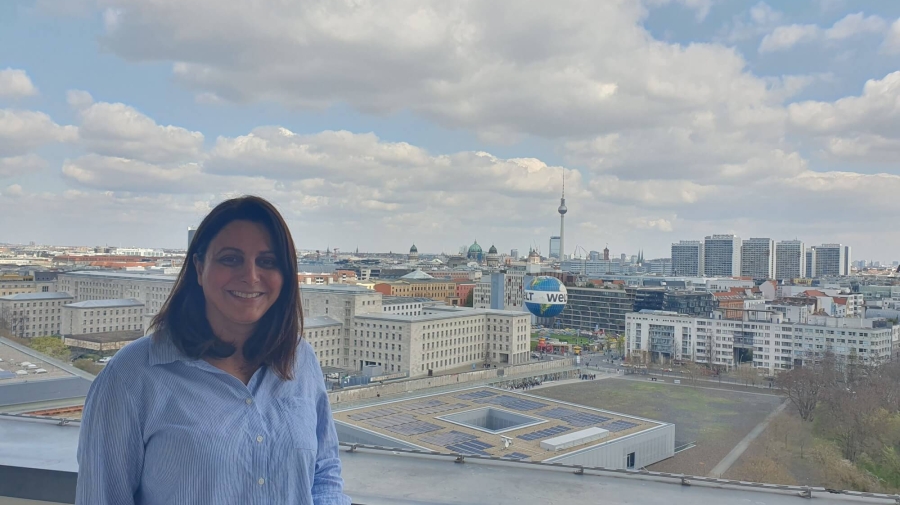
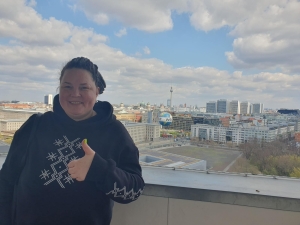
Taban at the Annual Meeting of the Action Network on Forced Displacement, standing on the balcony of the German Federal Ministry for Economic Cooperation and Development
Taban Shoresh is a spokesperson for the Action Network on Forced Displacement and founder and CEO of The Lotus Flower, an organization providing skills training, education, and mental health and psychosocial support (MHPSS) for women and girls conflict survivors in Kurdistan. She is an Iraqi refugee and has been featured on numerous international media channels, as well as speaking at international fora on forced displacement.
Through her work at The Lotus Flower, Taban significantly advances the Global Compact on Refugees (GCR) by easing pressures on host countries (GCR Objective 1) through the provision of essential services for conflict-affected women and girls in Iraq and the Kurdistan Region, such as education, skills training, and psychosocial support. She enhances refugee self-reliance (GCR Objective 2) by promoting long-term, sustainable support, including leadership development and capacity building, exemplified by initiatives like the Peace Centre. Her efforts to address root causes of forced displacement and promote peacebuilding contribute to creating conditions for safe and dignified return (GCR Objective 4). Taban also champions the GCR’s cross-cutting commitments to gender equality, protection from gender-based violence, and meaningful participation by ensuring women and girls are empowered to lead, access resources, and shape the solutions that affect their lives.
Talking about the challenges she faces in her work, Taban explained: "At The Lotus Flower, we operate in Iraq and the Kurdistan Region where we’re facing a dramatic decline in funding. Ongoing banking restrictions are making it increasingly difficult to function.
"It’s also becoming more dangerous, especially in terms of gender-based violence, with recent legal changes putting women and girls at even greater risk.
"All of this is making our work more challenging—and more urgent. We’re deeply concerned that we’ll be left behind, and that the progress we’ve worked so hard to achieve over the years could be undone.
"We want our supporters to understand: just because we’re not in the headlines doesn’t mean we don’t need help. In fact, we need your support now more than ever."
On the support she would like to see from other humanitarian actors and the international community more widely, Taban highlighted the need for greater inclusion of refugees, particularly women and girls in decision making processes and an understanding and recognition of the skills and experiences forcibly displaced people can bring to find durable solutions: "Meaningful participation must come with recognition and action. We need to be included in shaping solutions to the very problems we and our communities face.
"As a humanitarian with lived experience, like so many others, I don’t just want to respond to crises. I want to address the root causes, so that no one else has to endure what we have.
"We believe every person has the right to live safely and to thrive. We work hard to make that a reality, but to succeed, the power dynamics must shift. Recognition is the first step but it must be followed by long-term, sustainable support.
"That means access to funding, protection, and systems that truly enable our work from ensuring our safety, to resolving practical barriers like the challenges of operating in countries with limited or restricted systems. If the goal is lasting change, the infrastructure to support it must be just as strong.
"We need full recognition that we are the change-makers, deeply committed to resolving the very problems we face. But recognition alone is not enough. We need support that enables us to do the work.
"This means funding not just projects, but providing core funding that allows organisations like ours to grow, plan, and sustain impact. Without it, we’re trapped in cycles of short-term delivery rather than long-term change.
"We also need direct access to donors, to share our realities, and to co-create solutions that reflect true partnership. We should not be seen only as local implementers. When larger organisations or donors exit a country, it’s the local partners who stay behind, holding the responsibility. If we’re not supported from the beginning to build strong, sustainable structures, then when the project ends, we are left vulnerable, unable to sustain the work or ourselves.
"Sustainability must be a priority from the very start of any partnership. And true sustainability means listening, asking local organisations what we actually need. If we say we need help building our fundraising capacity, that should be embraced as a vital, future-proofing investment, not dismissed because it’s ‘not in the project scope’.
"There are countless examples I could share but it all comes down to this: listen to us, trust us, and build with us. That’s how we create lasting solutions, for everyone involved."
Taban highlighted how only through full inclusion of all voices is vital to achieve lasting change: "Investing in women and girls, including us in decision-making, and recognizing the real, positive impact of that inclusion is essential. But true change also means involving men, boys, and key community leaders in the process. The truth is, we need a holistic approach. Lasting change doesn’t happen in isolation. It requires everyone at the table."
Discussing the work she has done through the Network, Taban emphasized the impact that participating in such initiatives can have: "There are many projects I’m proud to be part of, so it’s hard to choose just one. But what truly stands out is being given the opportunity, as a local, frontline refugee women led organization is to be part of the decision-making process. That in itself is powerful.
"Having a seat at the table means we can help direct support where it’s needed most. This is what meaningful participation looks like. It allows us to lift up our sisters, because we know, firsthand, where and how that support will have the greatest impact."
Taban highlighted the importance of the Global Compact on Refugees and Global Refugee Forums in empowering refugee women leaders, and how engaging through them has enabled her organization to turn ideas into concrete actions: "The Global Compact on Refugees, and the Global Refugee Forum are powerful examples of meaningful participation for women leaders. I was honoured to be part of several multi-stakeholder pledges, most notably the Pledge on Gender Equality and Protection from Gender-Based Violence.
"I was involved both as a member of the Action Network on Forced Displacement and as a refugee woman leader representing The Lotus Flower. Through this process, we were able to pledge the creation of a Peace Centre in the Kurdistan Region of Iraq. With the support of the Action Network and BMZ, what began as a vision has now become a reality.
"We’re proud to be implementing this project and are hopeful it will succeed, not only for the communities it serves but as a model that can be replicated in other regions where women leaders from the Action Network are working.
"As a local partner, this opportunity has given us access and influence at an international level. It’s a clear example of how critical women leaders are to solving some of the world’s most urgent challenges, particularly in advancing peace and addressing gender-based violence."