Interview with Rebecca
Interview with Rebecca
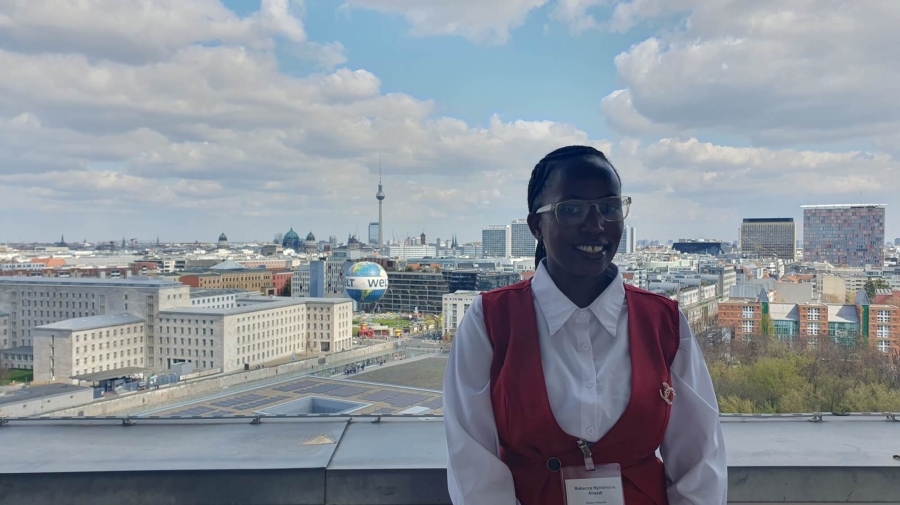
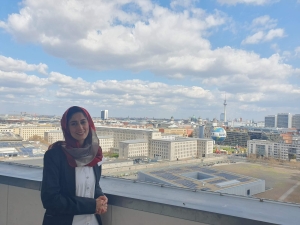
Rebecca at the Annual Meeting for the Action Network on Forced Displacement on the balcony of the German Federal Ministry for Economic Cooperation and Development.
Rebecca is a refugee from the Democratic Republic of the Congo, a member of the Action Network on Forced Displacement and the founder of She-Rendezvous, a refugee girls-led group in Uganda. Her work in Uganda advances key objectives of the Global Compact on Refugees (GCR) by easing pressures on host countries through community-building and solidarity among diverse refugee populations (GCR Objective 1), and enhancing refugee self-reliance through her organization She-Rendezvous and initiatives like Pad4All, which provide education, health awareness, and leadership opportunities for refugee girls (GCR Objective 2).
Rebecca’s advocacy for the inclusion of African refugees in global forums not only amplifies their voices but also offers technical insights that inform the development of more effective and inclusive policies, thereby playing a critical role in advancing access to durable third-country solutions (GCR Objective 3). Additionally, her strong focus on protecting girls from female genital mutilation (FGM), child marriage, and sexual violence reinforces the GCR’s cross-cutting commitment to gender equality and protection from gender-based violence.
Asked about the support she would like to see from other humanitarian actors and refugee-led organizations, as well as the international community more broadly, Rebecca called for unity and greater collaboration among refugees, and equal and fair treatment by everyone. "African refugees are less represented in Global Refugee Forums, assemblies, and events on issues affecting them. The support I would like to see from other refugee-led organizations is for them to prioritize the issues of all African refugees, regardless of country or race. Any African-led group that is privileged to be invited should represent all refugees and air their issues. This support could include collaboration and sharing research and information among ourselves as refugee-led group leaders, so that a Congolese refugee can amplify the voices of Sudanese, South Sudanese, Somalian, Ethiopian, Burundian, Rwandan… and vice versa. This would help all African refugees amplify each other's voices and live in solidarity, especially in a country like Uganda that hosts refugees from different countries, races, and religions."
"I want stakeholders, especially those at the global level, to treat all refugee issues and emergencies equally and fairly. To do this, they should ensure that all refugees from the African continent have representation in decision-making processes, just like other regions. They should also provide empowerment, opportunities, and ensure that all refugees from all continents receive adequate funds and support."
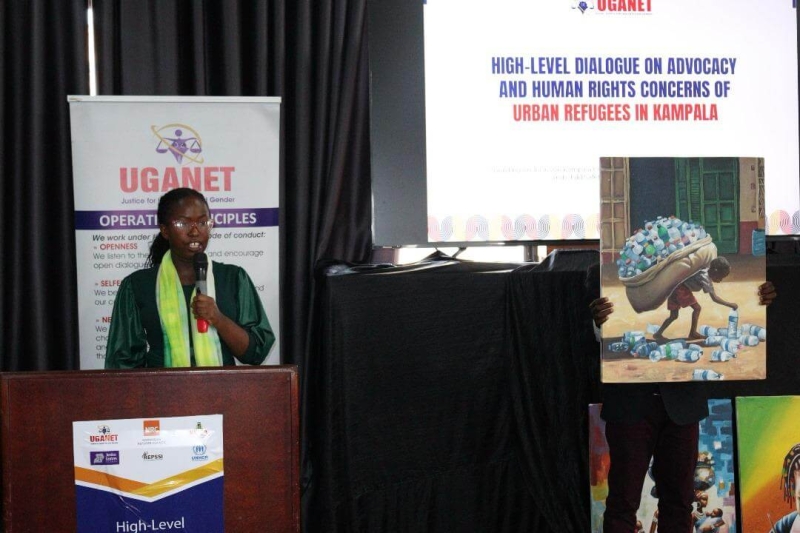
On the challenges she faces, Rebecca explained that not only does her organization have to grapple with limited resources, but that she personally fears for her safety and a lack of sense of belonging. "Personally, I face an identity crisis. Historically, my ancestors are from Rwanda, but my parents and I were born in the DRC. I grew up as a Congolese, speaking Kinyarwanda, which led to discrimination and fear of persecution. I've spent my life trying to fit in and be accepted by my country of origin. The Congolese don't accept me as their own, and Rwanda doesn't know me, so I don't know where I belong. This is a significant issue that many Rwandaphone Congolese people face. Even after leaving my country of origin, the Democratic Republic of the Congo, I still face discrimination in Uganda. Recently, the situation in Goma escalated, and Congolese refugees like me who speak Kinyarwanda were scared, even in our host community. We faced insecurity and terrorism, including from other Congolese, and we had no protection. This is a challenge I've accepted to live with, hoping that one day I'll find a country that will accept me.
"As a young refugee-led group leader, I also face challenges like limited resources and expertise. For instance, one of the projects I run is Pad4All, where we provide pads to young girls, especially those in school, to fight period poverty and educate them on sexual reproductive health and menstrual hygiene. I wish all sectors could partner with us to provide sanitary towels, which would be less of a burden for us, as fundraising is challenging. All sectors should work together to protect girls at risk of GBV, including sexual violence often perpetrated by family members. This includes ensuring access to shelters for survivors of FGM, child marriage, and other forms of abuse."
On what one-change would make the greatest difference, Rebecca highlighted the safety and security of women and girls. "Women and girls need protection and to live in a peaceful country where they are not afraid of sexual violence. They need a country with strong laws and policies to protect them from harmful practices like FGM and child marriage. A country that offers them the right and freedom to choose what they want to do with their lives."
Rebecca joined the Network this year, and when asked how she came to be a member, she said: "My brother, who is aware of the work I do and is my number one supporter and motivator, saw the application advert for the Network and forwarded it to me. He told me, 'This is where you belong', and luckily, I was selected to join and become a member of the Network."
The Network helps to amplify the voices of women like Rebecca, fearless and unstoppable advocates for the rights of displaced women and girls. Rebecca recently joined the Network and hopes in the future to be more involved in the implementation of the Global Compact on Refugees: "if there is an opportunity for me to join the Global Refugee Forum (GRF) or be involved in the GCR process, I will take it with open arms. I would be glad to join and represent black girl refugees from the African continent, who are often underrepresented in global refugee events."