Interview with Vlada Krasova Torres
Interview with Vlada Krasova Torres
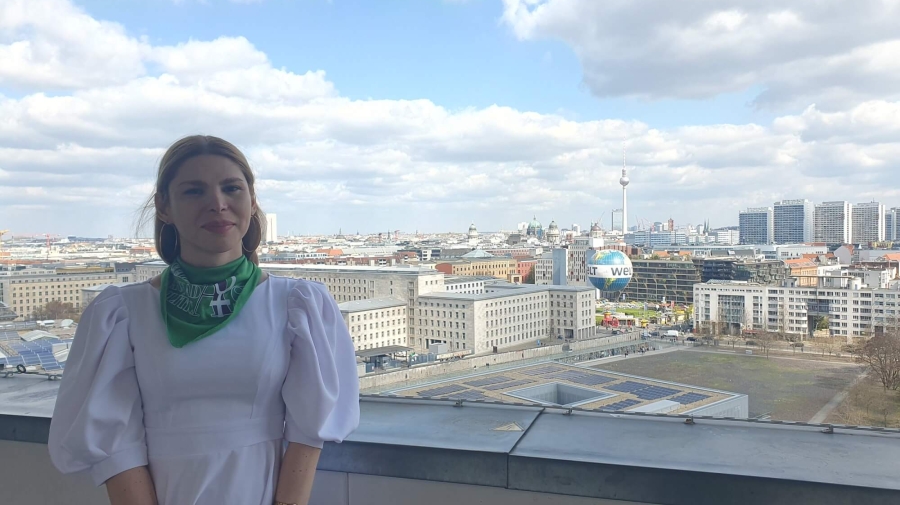
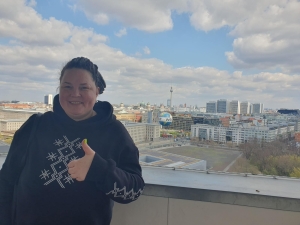
Vlada at the Annual Meeting of the Action Network on Forced Displacement standing on the balcony of the German Federal Ministry for Economic Cooperation and Development.
Vlada Krasova Torres is a member of the Action Network on Forced Displacement and a transgender refugee woman from Nicaragua. She is part of the Advocacy Commission of the Feminist League of Political Refugees of Nicaragua, as well as the feminist collective Escarlata. She works for the Regional Office of UNESCO San José in Costa Rica and has also written as a columnist for various publications.
Vlada’s work in Costa Rica advances the Global Compact on Refugees (GCR) by enhancing the self-reliance of trans and forcibly displaced women through leadership development, advocacy, and improved access to resources (GCR Objective 2). Her commitment to peacebuilding and post-conflict initiatives, such as those supported by the Women’s Peace and Humanitarian Fund (WPHF) in Colombia, contributes to creating conditions for safe and dignified return and reintegration (GCR Objective 4). Additionally, her strong advocacy for intersectional inclusion and the redistribution of power reflects the GCR’s cross-cutting commitment to gender equality and inclusive, gender-responsive approaches.
Talking of the challenges faced by refugees, Vlada highlighted some of the political and social structures endangering transgender refugees like herself: "One of the most important challenges we face today is living under system that normalizes abandonment, exclusion, and violence toward those of us who are seen as disposable bodies and territories: women, trans people, racialized people, the poor, and the displaced. This logic of oppression is not accidental; it is structural. It is expressed in the lack of access to healthcare, in criminalizing migration policies, in the impunity of femicides, and in the systemic violence against human rights defenders.
"To this, we must add the extractive dynamics that affect not only our geographic territories but also our bodies. Forcibly displaced women — and particularly trans women — continue to be seen as objects of assistance or symbolic resources for 'development' without real recognition of our struggles, decisions, or agency.
"We are also confronted with forms of humanitarian engagement that, while well-intentioned, often reflect neocolonial dynamics—where solutions are designed and implemented from actors with limited understanding of, or alignment with, our lived realities. Our voices are frequently included too late, in a tokenistic manner, or not at all."
But she believes change is possible, and hopes to see a shift that leads to real autonomy for women: "I strongly believe that the change with the greatest impact on the lives of women and girls — especially in forced displacement contexts — would be the structural transformation of power: ensuring that women, in all our diversity, can make decisions about our lives, our bodies, our territories, and our futures.
"This means dismantling systems that are deeply patriarchal, racist, transphobic, and colonial, which continue to determine who lives with dignity and who does not. It means ensuring real access to education, comprehensive healthcare (including sexual and reproductive health), economic justice, and effective protection mechanisms against violence and discrimination.
"But it is not enough to include us on the margins of systems that are already failing. What we need is a redistribution of political, economic, and symbolic power — and that is only possible if investment is made in the leadership of women, especially those who have been historically silenced: Indigenous, Afro-descendant, disabled, trans, refugee, and displaced women.
"The greatest shift would be moving from ‘empowerment' as a slogan to autonomy as reality, in a world that recognizes the wisdom of our ancestresses, the right to our identity, and the urgency of living without fear, with freedom and justice. That would be the true turning point."
Asked about the support she would like to see both from the humanitarian sector and the international community more widely, Vlada called for more funding and greater equality: "As a trans woman and a member of an international network of women fighting against forced displacement, we consider it urgent that the humanitarian sector takes bolder and more coherent actions in line with the commitments outlined in the GCR the Global Refugee Forum, and the Multi-stakeholder Pledge on Gender Equality and Protection from Gender-Based Violence.” Such actions are reflected in the Report and recommendations from the 2024 UNHCR Global Consultations with NGOs to better support and include women- and LGBTQI+-led organizations.
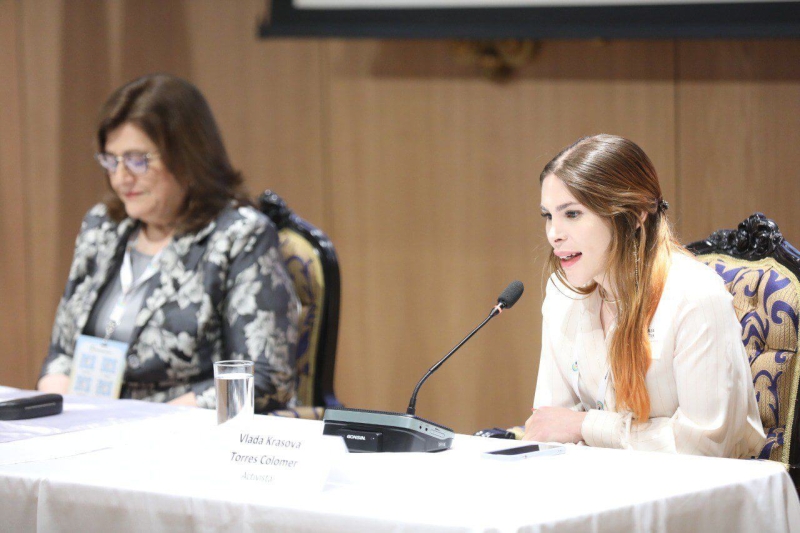
Vlada continued: "These frameworks offer a clear roadmap: to center humanitarian action on human rights, gender equality, and the meaningful participation of displaced persons — especially those of us who have been historically marginalized.
"From this standpoint, I would like to see a stronger commitment from humanitarian actors to provide direct and sustained funding to women-led organizations, including those led by trans women and forcibly displaced LGBTIQ+ individuals. We need safe spaces, adequate resources, and real power to influence the decisions that affect our lives.
"It is essential that decisions about asylum, protection, and development policies are not made without us — those of us who live with the consequences of those decisions.
"I would like to see fewer extractive and symbolic interventions, and less participation that is reduced to ticking boxes or meeting inclusion requirements without guaranteeing real influence. It is also urgent to see less silence in the face of the rise of anti-rights discourses and policies, which today are eroding international law, weakening democratic institutions, and directly attacking rights such as gender identity.
"What we need is an international community that stops acting for us and starts acting with us, recognizing our voices, knowledge, struggles, and proposals as essential to building real peace, justice, and democracy."
When asked of which of the projects the Action Network has supported, Vlada replies: "One of the projects I am most proud of is the Call for Proposals in Colombia launched through the Women’s Peace and Humanitarian Fund (WPHF). This initiative has played a critical role in supporting grassroots women-led organizations to actively participate in both formal and informal peace processes, and to contribute to the implementation of peace agreements in Colombia.
"What makes this project stand out is its strong emphasis on representation, leadership, and institutional strengthening. By financing high-impact and innovative initiatives, the WPHF has created space for local voices — especially women and girls most affected by conflict and displacement — to influence decision-making, advocate for their rights, and build sustainable peace from the ground up.
"The impact has been both measurable and inspiring: organizations that were previously under-resourced now have the tools to engage in peacebuilding, support survivors of conflict-related violence, and push for gender-responsive implementation of the accords. I believe this model could and should be replicated in other post-conflict contexts, where the inclusion of women in peace processes is still lacking but urgently needed. It is a clear example of how funding can shift power and foster long-term transformation."
Joining the Network has been a positive journey for Vlada – one filled with support and hope. She reflects: "I joined the Network thanks to the insistence and loving support of my compañeras from the collective I work with. They encouraged me to take this step, convinced that my voice and experience could contribute to the regional work being woven from feminist perspectives in the context of forced displacement. Although I’ve only been a formal member for a few months, I’ve felt a deep sense of belonging, sisterhood, and collective commitment from the start.
"From the Latin American women’s space within the Network, we are building concrete proposals that reflect our realities and resistances. Among these, we are preparing initiatives such as strategic litigation support, webinars on displacement from a gender perspective, and workshops on using the universal and inter-American human rights systems, especially designed for forcibly displaced women, community leaders, and trans defenders.
"My arrival to the Network has been a process of affirmation: of my identity, my political voice, and our collective capacity — as women in all our diversity — to influence, resist, and transform the systems that have historically excluded us."