Interview with Safia Ibrahimkhel
Interview with Safia Ibrahimkhel
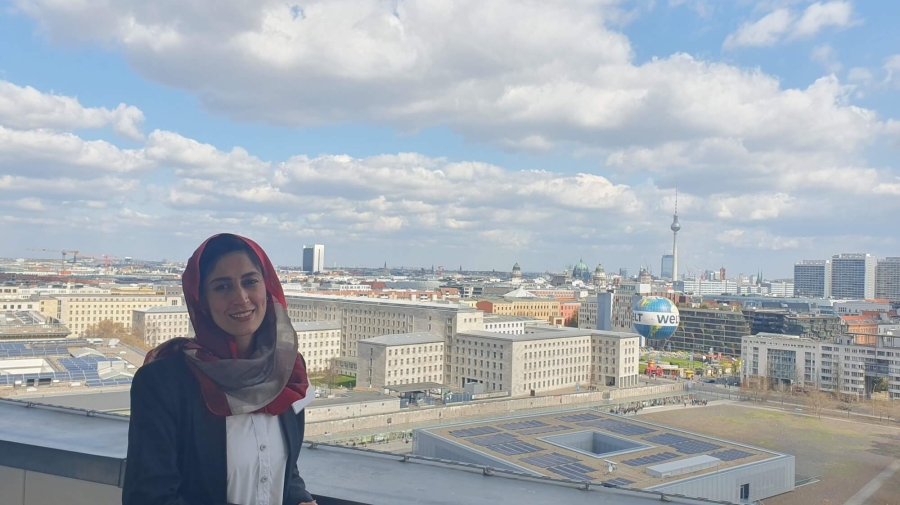
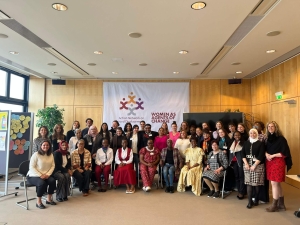
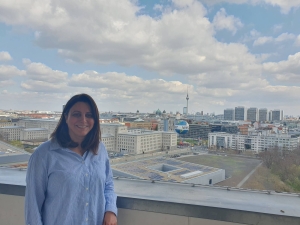
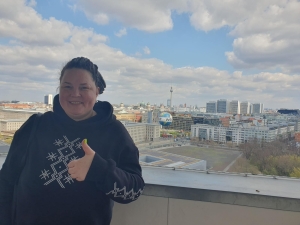
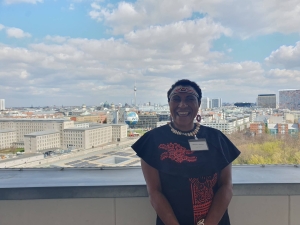
Safia at the Annual Meeting of the Action Network on Forced Displacement, standing on the balcony of the German Federal Ministry for Economic Cooperation and Development
Safia Ibrahimkhel is an Afghan refugee, member of the Action Network on Forced Displacement and Co-Founder and former Co-Chair of UNHCR’s Global Youth Advisory Council. She was awarded as a Youth Peace Ambassador for Pakistan and Afghanistan Youth Dialogues in 2019 and has worked for the Refugee-Led Research Hub at Oxford University. Safia's work in Pakistan advances the Global Compact on Refugees (GCR) by promoting community-based approaches and collaboration with host communities to ease pressures and foster social cohesion (GCR Objective 1). She strengthens refugee self-reliance (GCR Objective 2) through advocacy focused on education, protection, and economic empowerment for displaced women and girls. Additionally, her engagement with international stakeholders and policy advocacy contributes to expanding access to third-country solutions and shaping durable, inclusive refugee policies (GCR Objective 3).
Safia has been involved in the implementation of the GCR since 2019 and explains: "I had the privilege to attend the first Global Refugee Forum (GRF) in 2019 and the second GRF in 2023 as the member of GYAC Global Youth Advisory Council and co-sponsor for education and protection. Forcibly displaced persons especially women, children and people with different gender need action instead of only discussion or promises. Pledges presented at the GRF shouldn’t be only documented or recorded on a piece of paper, but they should be implemented in meaningful and productive ways."
On the challenges she sees, Safia highlighted issues surrounding gender-based violence (GBV), including intimate partner violence and child marriage: "Since my school age I am passionate about the rights of young people, especially adolescent girls and young women. I started advocating for their rights to prevent child marriages, domestic violence against women and advocating for policy changes, mobilizing communities, and collaborating with stakeholders to advance the interests of displaced women and girls.
"Forcibly displaced women face significant challenges, including violence, discrimination, and economic hardship in both refugee and host communities. They require comprehensive support from various sectors, including governments, NGOs, and private sector, focusing on protection, access to resources, education and long-term recovery."
On how to address these issues, Safia talked about the difference which the international community could make through better levels of reporting, and closer work with community members on problems being faced: "The international community and stakeholders should collaborate to gather and share first-hand knowledge of how issues affect local populations in their daily lives. This localized insight is essential for informing more effective funding decisions and ensuring that support is tailored to real needs. Secondly, displaced community members should be involved in planning and programming. Their involvement could include sharing feedback, offering skills, contributing knowledge, sharing resources, and more. Working with communities will also support stakeholders to plan and implement the projects or activities according to the needs and priorities of the communities."
Safia is a passionate advocate for forcibly displaced women's and girls’ access to education: "One single change that could significantly improve the lives of women and girls is ensuring equal access to quality education for all. This would empower girls to become resilient and make informed choices, increase their awareness of their rights, and improve their economic opportunities, ultimately contributing to a more equitable society." These are key elements of the Multi-stakeholder Pledge on Securing Sustainable Futures - Towards a Shared Responsibility to Uphold the Right to Education and Include Refugee Children in National Education Systems, working to enhance inclusion of refugee children in national education systems, with an emphasis on gender equality.
Talking about how she became involved in the Network, Safia replied: "When BMZ posted the links of the opportunity to become the member of the Action Network, I applied and luckily got selected to be part of this incredible and diverse group to amplify the voices of displaced women and LGBTQI community. Ensuring their access to legal documentation and actively involving women in policy making and peace-building processes."
"My experience of being a refugee woman has equipped me with a deep understating of the challenges faced by displaced women in a fragile situation. Working with refugee and host communities and with various organizations supporting forcibly displaced persons, refugees, and asylum seekers enhanced my expertise and resilience."
On what she would like to achieve in the future through the Network, Safia highlighted her hope to further access to education for all girls: "I am very interested and looking forward to the initiatives we will work on this year, I would be delighted to work on initiatives which focus on education, formal or informal learning opportunities, conflict resolution and capacity building training. As the Network is about women's potential in peace and leadership it will be an opportunity to address the issue on girl’s education in Afghanistan, as Taliban government deliberately deprived at least 1.4 million girls of their right to an education during its three years in power. By understanding the challenges faced by Afghan women, we can work towards creating supportive environments and work with the international community to bring pressure to open the doors of education. As an equitable society, women empowerment and achieving peace is not possible without education."